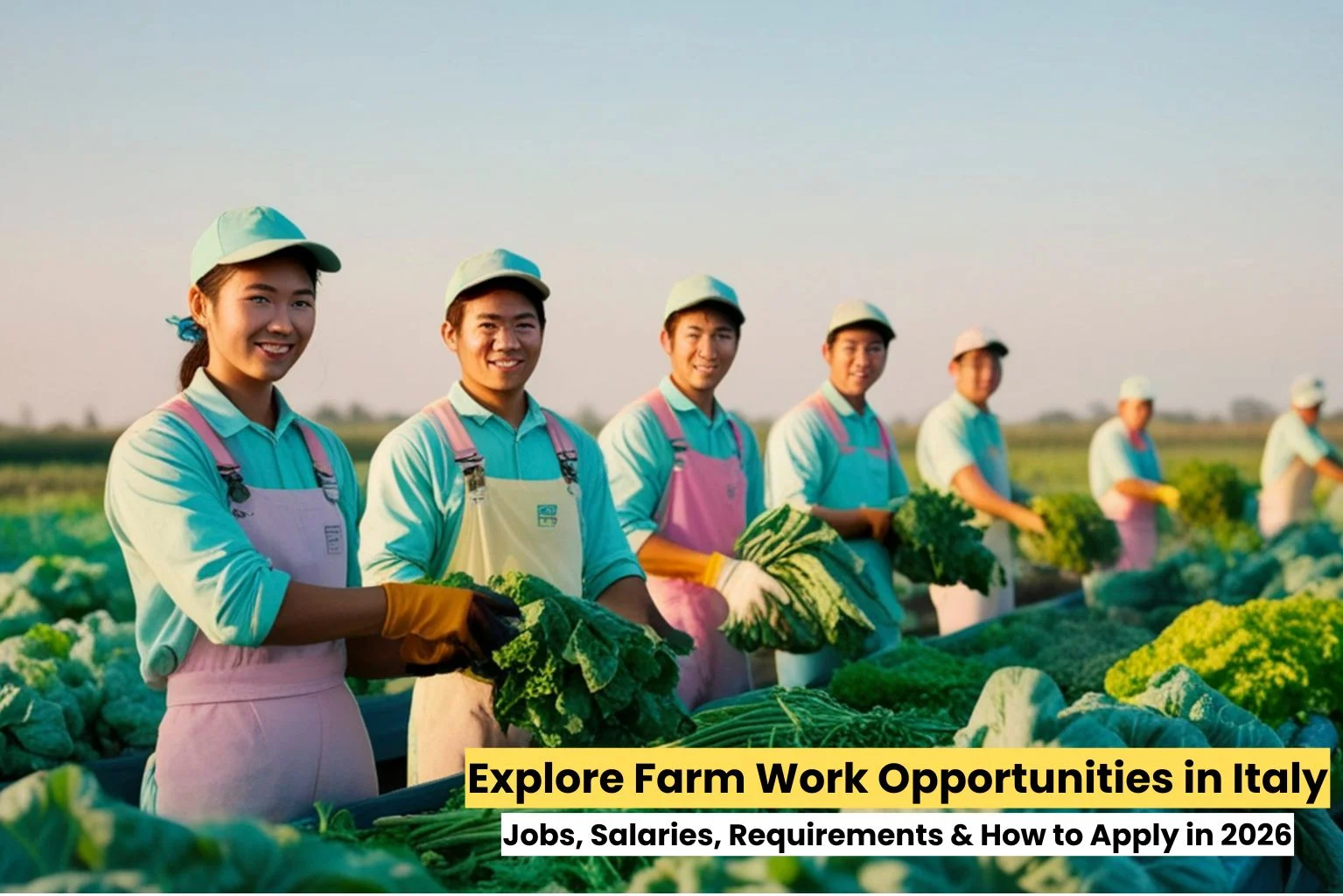
Italy is well known for its vineyards, olive groves, fruit orchards, vegetable farms, dairy operations, and other agricultural businesses. Behind this important industry is a large workforce that helps with planting, harvesting, packing, greenhouse operations, livestock care, vineyard maintenance, and general farm activities.
For job seekers interested in practical, hands-on employment, farm work opportunities in Italy can provide a useful route into the Italian labour market. Some agricultural positions are seasonal, while others may be available for longer periods depending on the farm, location, employer, and type of work.
International applicants should understand one important point before applying: finding a vacancy does not automatically mean that an employer will recruit a worker from outside the European Union. Non-EU workers normally need an eligible Italian employer to begin the work-authorisation process before the employee can apply for the appropriate Italian work visa.
Italy’s current immigration programme specifically includes seasonal employment in agriculture. For 2026, the Italian government authorised 88,000 entries for seasonal employment across eligible sectors, with agriculture forming an important part of the seasonal-worker system.
Why Consider Farm Work in Italy?
Agricultural work can be attractive to people who prefer practical jobs rather than office-based employment. Many entry-level positions focus more on physical ability, reliability and willingness to work than on university qualifications.
Another advantage is the variety of agricultural activities across Italy. Different regions are known for different products. Vineyards require workers for grape growing and harvesting, olive-producing regions need seasonal picking staff, and fruit and vegetable farms regularly require workers during planting, maintenance and harvest periods.
Some reasons people consider agricultural jobs include:
- Opportunities for workers with limited formal qualifications
- Seasonal and full-time positions depending on the employer
- Opportunities to develop practical agricultural skills
- Experience working in the European agricultural sector
- Jobs involving fruit, vegetables, vineyards, livestock, greenhouses and farm equipment
- Potential opportunities in different Italian regions
- Legal employment protections when workers are hired through proper contracts
Applicants should remember that agricultural work can be physically demanding. Tasks may involve standing for long periods, bending, carrying containers, working outdoors and performing repetitive activities. Weather conditions can also make the work challenging.
Common Farm Jobs Available in Italy
Agriculture covers far more than fruit picking. Vacancies vary according to the season and type of agricultural business.
| Position | Typical Duties | Approximate Monthly Pay |
|---|---|---|
| General Agricultural Worker | Planting, field maintenance, harvesting and general farm work | €1,000–€1,500+ |
| Fruit Picker | Picking, sorting and handling fruit | €950–€1,400+ |
| Vegetable Farm Worker | Planting, harvesting, cleaning and packing vegetables | €1,000–€1,400+ |
| Vineyard Worker | Vine maintenance, pruning and grape harvesting | €1,100–€1,600+ |
| Olive Harvest Worker | Collecting, sorting and preparing olives | €1,000–€1,500+ |
| Greenhouse Worker | Plant care, irrigation, harvesting and greenhouse maintenance | €1,000–€1,500+ |
| Farm Packing Worker | Sorting, grading, packing and preparing agricultural products | €1,000–€1,500+ |
| Livestock Farm Assistant | Feeding animals, cleaning facilities and general livestock care | €1,100–€1,600+ |
| Tractor/Farm Machinery Operator | Operating agricultural machinery and equipment | €1,300–€1,800+ |
| Experienced Farm Supervisor | Coordinating workers and farm activities | €1,500–€2,000+ |
Important: These are approximate figures rather than guaranteed salaries. Actual earnings depend on the employment contract, hours worked, province, experience, position and applicable collective agreement.
Recent Indeed salary data provides a useful reference. As of September 2026, Indeed reported an average base salary of approximately €1,310 per month for an agricultural worker (operaio agricolo) in Italy, based on reported salary information. Its published range was approximately €881–€1,948 per month. Another category, agricultural labourer or bracciante agricolo, showed an average of around €1,186 per month.
Seasonal Farm Jobs in Italy
Seasonal agricultural employment is particularly important for international workers.
Seasonal demand may increase during:
- Fruit harvesting
- Grape harvesting
- Olive harvesting
- Vegetable harvesting
- Planting seasons
- Greenhouse production periods
- Agricultural product sorting and packing
Under Italy’s immigration rules, seasonal employment for non-EU workers is specifically permitted in the agriculture and tourism/hospitality sectors within the applicable immigration quotas. Italy also allows qualifying seasonal employment on a part-time basis, provided the average working time meets the applicable legal requirement.
For 2026, applications for seasonal agricultural-worker entries under the Decreto Flussi system began on 12 January 2026. Applications can continue until 31 December 2026 subject to the availability of quotas.
The government also allocated additional seasonal agricultural quotas during 2026, including 5,389 additional places announced in May for applications submitted through representative agricultural employer organisations.
Who Can Apply for Farm Jobs in Italy?
The exact requirements depend on the vacancy and employer, but applicants commonly need to meet several basic conditions.
Basic Eligibility
A typical farm worker should normally:
- Be legally eligible to work in Italy or qualify for the required work-authorisation procedure
- Be physically capable of performing agricultural work
- Be willing to work outdoors or in greenhouses
- Be able to follow health and safety instructions
- Be reliable and punctual
- Be able to work individually and as part of a team
- Meet any experience requirements mentioned by the employer
Many general farm roles do not require a university degree.
Previous experience in agriculture can improve an applicant’s chances, especially for jobs involving tractors, agricultural machinery, vineyards, livestock or specialised crops.
Language Skills
Basic Italian can be extremely useful.
Workers may need to understand:
- Safety instructions
- Daily tasks
- Working hours
- Equipment instructions
- Farm rules
- Supervisor directions
Some employers may accept workers with limited Italian, particularly for basic seasonal work, but learning common workplace expressions before travelling is strongly recommended.
Documents You May Need
Documents vary according to your nationality, employer and visa category, but applicants should generally prepare:
- Valid passport
- Updated CV
- Recent photographs
- Employment offer or employment contract when issued
- Work authorisation or Nulla Osta, where required
- Visa application form
- Proof of residence required by the relevant Italian embassy or consulate
- Educational or training certificates if relevant
- Agricultural experience certificates if available
- Driving licence for machinery or driving-related positions if requested
- Other documents required by the relevant Italian diplomatic mission
Always check the specific requirements of the Italian embassy or consulate responsible for your place of legal residence because documentation requirements can differ.
Italy Farm Work Visa Requirements for Non-EU Applicants
Workers from European Union countries generally do not require an Italian work permit to take employment in Italy. EURES confirms that EU citizens can normally work as employees or self-employed persons in Italy without obtaining work authorisation, subject to limited exceptions.
The situation is different for people applying from outside the EU.
For many non-EU agricultural workers, the process begins with the employer in Italy, not with the employee simply submitting a work-visa application independently.
The basic process generally works as follows.
1. Find an Italian Employer
The worker searches for a genuine agricultural vacancy and applies directly to the employer.
2. Receive a Job Offer
If selected, the employer confirms that they wish to hire the applicant.
3. Employer Requests the Nulla Osta
The Italian employer normally submits a request for work authorisation known as a Nulla Osta through the relevant Italian immigration procedure.
Official Italian immigration guidance states that submission of the employer’s request for a Nulla Osta is the starting point for hiring a non-EU worker through the applicable system.
4. Work Authorisation Is Processed
For seasonal workers, the application must fall within the applicable immigration rules and available quotas.
5. Apply for the Italian Work Visa
After the required authorisation has been granted, the worker applies for the appropriate visa through the Italian embassy or consulate responsible for their country or place of residence.
Italian consular guidance confirms that subordinate employment visas generally require the employer to obtain the Nulla Osta from the Sportello Unico per l’Immigrazione before the visa process is completed.
6. Travel to Italy
Once the visa is approved, the employee can travel to Italy within the conditions and validity period of the visa.
7. Complete Residence Procedures
Workers staying under the applicable employment immigration system must complete the required residence-permit procedures after arriving in Italy. Italy’s official visa portal explains that foreign workers entering with the necessary work authorisation must follow the required process for obtaining their residence permit.
Because immigration procedures can change, applicants should always verify the latest instructions through official Italian government or consular websites before paying fees or submitting documents.
How to Apply for Farm Jobs in Italy: Step-by-Step
Step 1: Prepare a Simple European-Style CV
Your CV should clearly show:
- Full name
- Contact information
- Work experience
- Agricultural experience
- Languages
- Driving licence
- Machinery experience
- Education
- Relevant skills
- Availability
Keep your CV clear and focused.
Step 2: Search Using the Right Job Keywords
Searching in Italian can produce more results.
Useful keywords include:
Operaio agricolo — agricultural worker
Bracciante agricolo — farm labourer
Lavoro agricolo — agricultural work
Raccolta frutta — fruit harvesting
Raccolta olive — olive harvesting
Vendemmia — grape harvest
Lavoro stagionale agricoltura — seasonal agricultural work
Addetto serra — greenhouse worker
Step 3: Use Reliable Job Portals
Several websites can help you search for agricultural vacancies.
EURES – European Employment Services
EURES provides European vacancies, mobility information, career guidance and information about living and working in Italy. Its vacancy database includes jobs supplied through public employment services and EURES members and partners.
Visit EURES Jobseekers Portal
EURES Italy Information
Living and Working in Italy – EURES
Cliclavoro – Italian Ministry of Labour Portal
EURES identifies Cliclavoro as the Italian Ministry of Labour portal publishing employment opportunities and career resources.
Visit Cliclavoro
Indeed Italy
Indeed regularly carries hundreds of agriculture-related listings across Italy. Recent listings have included agricultural workers, olive-picking staff, vineyard workers and other farm positions.
Search Agriculture Jobs on Indeed Italy
Official Italy Visa Portal
Use this for official visa information rather than relying entirely on employment agencies or social media posts.
Visa for Italy – Official Portal
Step 4: Apply to Multiple Genuine Vacancies
Do not depend on a single application.
Tailor your CV to the position and briefly mention:
- Your agricultural experience
- Availability
- Relevant physical or technical skills
- Language ability
- Whether you currently have permission to work in Italy
If you require a work-authorisation procedure, be transparent about your immigration status.
Step 5: Attend the Interview
Interviews may be conducted through:
- Telephone
- Video call
- Online meeting
- In-person interview
Ask the employer about duties, location, contract duration, working hours, salary and accommodation arrangements.
Step 6: Verify the Employment Offer
Before travelling or paying anyone, confirm that the employer and job are genuine.
Be cautious if someone:
- Guarantees a visa without an employer
- Demands unusually large advance payments
- Refuses to provide employer information
- Offers unrealistic salaries for basic farm work
- Uses only messaging applications with no verifiable business details
- Claims that a tourist visa automatically allows agricultural employment
Legal employment should follow the proper Italian employment and immigration process.
Skills That Can Improve Your Chances
Although many entry-level farm positions require limited formal education, the following skills can make an applicant more competitive:
- Fruit and vegetable harvesting experience
- Vineyard experience
- Olive picking
- Irrigation knowledge
- Greenhouse experience
- Livestock handling
- Tractor operation
- Farm machinery experience
- Packing and sorting
- Basic maintenance skills
- Driving licence
- Basic Italian
- Physical stamina
- Teamwork
Workers who can operate agricultural machinery or perform specialised tasks may have access to more advanced positions than applicants seeking general labour jobs.
Frequently Asked Questions
1. Can foreigners apply for farm jobs in Italy?
Yes. Foreign workers can work in Italy if they meet the applicable employment and immigration requirements. Non-EU workers generally require the relevant work-authorisation and visa process, while EU citizens normally do not require a work permit.
2. How much can a farm worker earn in Italy?
Salary varies significantly by job, location, experience, working hours and employment agreement. Indeed reported an average of approximately €1,310 per month for agricultural workers in Italy as of September 2026, while agricultural labourers were reported at around €1,186 per month. These figures should be treated as market estimates rather than guaranteed wages.
3. Do I need experience to work on an Italian farm?
Not always. Entry-level harvesting, picking, sorting and general labour jobs may provide opportunities for candidates without extensive experience. Specialised positions involving machinery, livestock or supervision are more likely to require previous experience.
4. Can I apply for an Italian farm work visa without a job offer?
For the standard employer-sponsored route, the process normally begins with an Italian employer requesting the necessary work authorisation. Applicants should therefore focus on finding a genuine employer rather than assuming they can independently obtain a seasonal work visa first.
5. Are farm jobs in Italy seasonal?
Many are, particularly jobs connected with fruit, grapes, olives and vegetable harvesting. However, agricultural businesses may also advertise longer-term positions involving livestock, greenhouse operations, machinery and general farm maintenance.
6. Where can I find legitimate farm job vacancies?
Start with reputable sources such as EURES, Cliclavoro, established recruitment agencies, verified company websites and recognised employment portals. Avoid anyone promising guaranteed visas or employment in exchange for large unofficial fees.
Conclusion
Farm work in Italy can offer opportunities for people interested in agriculture, seasonal employment and practical outdoor work. Positions range from fruit picking and olive harvesting to vineyards, greenhouses, livestock farms, packing operations and agricultural machinery.
For international applicants, the strongest approach is to prepare a professional CV, search using both English and Italian keywords, apply directly to legitimate employers and understand the legal immigration process before making travel arrangements.
Non-EU candidates should pay particular attention to Italy’s Decreto Flussi system and the employer-led Nulla Osta procedure. In 2026, Italy continues to provide legal entry opportunities